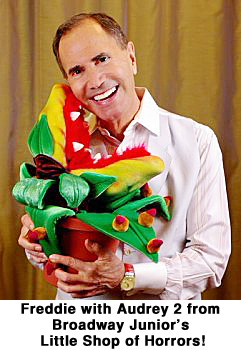
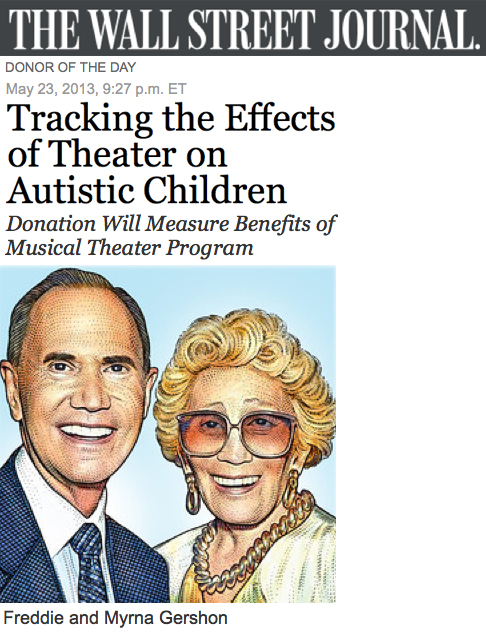
 Webmaster’s Note: This article appeared in the Wall Street Journal on 23 May 2013, naming Myrna and Freddie Gershon as the paper’s “Donors of the Day.” See end of article for links on this blog to related stories.
By MELANIE GRAYCE WEST
As executives in the entertainment industry, Myrna and Freddie Gershon had seen it all. But a theatrical performance put on by students of P 94 middle school in Manhattan, a special education school, changed their perspective on theater and has inspired a philanthropic legacy.
The couple—both in their 70s—made their careers, and a lot of their wealth, in the entertainment industry during the 1970s. Mrs. Gershon was a motion-picture executive who created merchandise and licensing deals. Her greatest hits include Flintstones vitamins, the Pebbles breakfast cereals and a deal with J.C. Penney to exclusively sell a white polyester suit inspired by “Saturday Night Fever.” That film also spawned a cologne that “smelled like Bay Ridge, Brooklyn,” quips Mr. Gershon.
By trade, Mr. Gershon is a lawyer who worked for Robert Stigwood Group, with clients that included the Bee Gees, Eric Clapton and film soundtracks for “Grease” and “Saturday Night Fever.” Later in life, he became chairman and chief executive of Music Theatre International (MTI), a licensing company. Nearly 20 years ago, Mr. Gershon came up with the idea to create shortened versions of major musicals that could be performed in schools. His “Broadway Junior Collection” shows have been performed some 300,000 times, he says.
A few years ago and with the Shubert Foundation, MTI began a program with the New York City Department of Education to bring musical theater education to underserved middle schools. A middle school of P 94, which primarily serves children on the autism spectrum, was one of the included schools.
The Gershons attended a performance at the school and “saw what music and theater and dance could do to a nonverbal child,” recalls Mrs. Gershon. “It was mind-boggling.” Parents and members of the audience cried. “We cried,” she says.
P 94 only had a three-year commitment from the Department of Education to put on the musical theater program. On the fourth year, Mr. Gershon says he was approached by the school’s principal, Ronnie Shuster, to continue the program.
“I said, ‘How much?'” recalls Mr. Gershon. The estimated cost was $75,000 and Mrs. Gershon said, “Just give it to them.” They funneled the gift through ArtsConnection, a New York nonprofit.
After another successful year, the Gershons asked Ms. Shuster her wish. She wanted to bring musical theater education to all five locations of her primary and middle schools. Mr. Gershon said he wanted to see such a program evaluated by an expert and documented with research.
The new program began this spring with a $250,000 gift from the Gershons. All P 94 schools now have a musical theater program and performances were held this month.
Anecdotally, the musical-theater program has encouraged collaboration between students. The shows have helped children to develop language, as some children are able to sing, but not speak. Reading has improved. The performances inspire courage in the children and helped them with their attention span.
“It’s like a magic wand was placed over them,” says Mr. Gershon.
The performances have allowed parents and families the universal pleasure of seeing their child perform on stage. It’s also given the Gershons a focus in their giving; they want to learn from this program, make it better and see it grow.
“We are in the homestretch of our life,” says Mr. Gershon. “Why not just have fun and do good things?”
Click here to see a previous post about this program.
Click here to see a previous post that links to a Huffington Post blog Freddie wrote about the program.
Click here to see ArtsConnection contribution page. This provides the following info on how to make special inquires: If you have any questions or would like to make a gift of stock, please contact our Development Department at 212-302-7433 ext. 470, or email us at Email HendershotK


 The class of 2012 arrived this summer in New York after being flown from different states, being whisked off to their hotel in the center of Times Square. Everything is paid for. It’s not just a fancy trip to see shows and have a good time. It’s a combination of having a good time and eight people getting to know each other and learning more skills. Myrna and I attend. We all gathered and sat with Ken Billington (one of the great lighting designers of New York), who gave of himself (the greatest gift he could give). Ninety seven Broadway musicals to his name, Ken knows his business. He concluded a virtuoso teaching seminar knowing the financial limitations of schools and explained how to make it work with Billington secrets imparted to them. He ended by saying “If I’ve done my job right, you are never aware of my lighting. It just serves the work.” That says everything about collaboration and the essence of creating any show.

 Raising the awareness of America and its local communities to the role of the teacher is the Gershon family’s little way of stepping forward and up to the plate to tap into our greatest resource, viz.: teachers who have not been beaten down by the system; teachers who have not been made to feel that they are part of a society which pays you more only because you’ve “lasted longer” through seniority or keeps you employed because your kids score better on tests through cramming and jamming info into their memory banks… (at least just long enough to take the test!) That is not what teaching is all about. That is not learning.
 Fifty states utilize Broadway JR. to perform the same function. Four million U.S. students have heretofore participated in 70,000 separate productions of JR. musicals over the last 17 years. Those grade school students represent households with over eleven million Americans. This program makes the world a better place and makes the children better prepared to be good citizens working collaboratively and collegially, utilizing their imagination, creativity and inventiveness as well as doing an awful lot of hard work … and enjoying the hard-work ethic.
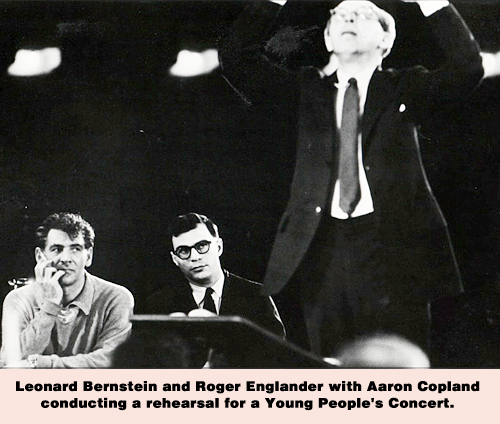 In the late 1950’s, William S. Paley (who was founder and CEO of CBS) wanted to broadcast Young People’s Concerts with America’s “glam” emerging star, conductor/composer Leonard Bernstein. Columbia Records (a division of CBS) recorded Maestro Bernstein as well as the New York Philharmonic. Maestro Bernstein, along with his buddy, Roger Englander (they had known each other for over a decade) were juxtaposed on the project. Roger and Lenny met originally at Tanglewood and studied with Serge Koussevitzky. Roger (a highly trained musician) was self-effacing and fascinated with traditional music from theatre, opera and the serious classics. He was also intrigued by new media and new forms of technology and their potential impact on communication and media. Lenny was fascinated by all things as well as being flamboyant, theatrical, photogenic, oozing star power and charm. Their collaboration became historic.